
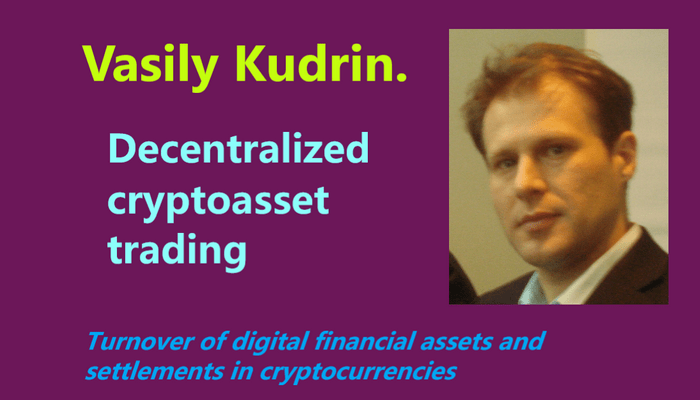
Vasily Kudrin, Co-associate of Goldman Digital, made a highly rated speech on decentralized exchanges and asset trading at the business conference devoted to digital financial assets and settlements in cryptocurrencies.
Presentation: ENG | RUS
VIDEO [Russian; Translation Support]
Coherent exposition of the master class
1. Introduction and Context of the Speech. The author introduces the topic — the evolution of decentralized trading and exchanges (DEXs). Vasily Kudrin briefly outlines his professional background, which includes work in financial area, traditional business, and the crypto industry in executive roles. This presentation is positioned as a continuation of his previous lectures on the blockchain ecosystem.
2. Legal Regulation as a Reaction to Trends. While the speech is formally about legal regulation, the speaker expresses skepticism about states’ ability to effectively govern technological trends. As an example, he cites Russia’s Digital Financial Assets (DFA) law and subsequent bills, which tend to react to established realities rather than shape them proactively.
3. Global Transformation and Different Regulatory Approaches. Vasily Kudrin says that the global economy and tech sector are undergoing a transformation, to which different countries respond in different ways. Examples include Kazakhstan, which passed mining legislation, and Dubai, which began licensing crypto companies. These measures illustrate attempts to integrate the new industry into a legal framework.
4. Temporary Role of Licensing and Regulators. Licensing, as seen in Dubai, is viewed as a temporary way to stimulate industry growth by creating regulated intermediary companies. These intermediaries connect decentralized ecosystems with traditional processes. However, in the long run, as decentralization matures, the very need for such licensed intermediaries may disappear.
5. Paradoxes of Regulation. The speaker notes that in some countries transactions with NFTs (non-fungiblie tokens, or unitary digital rights) are de jure unregulated, even though blockchain by its nature is already a decentralized ledger, making additional state registration redundant. Despite the lack of clear regulation, technology adoption is significant—approximately one-eighth of the population uses crypto wallets.
6. Contribution of Russian-Speaking Developers and the Futility of Bans. The speaker notes that Russian-speaking IT specialists play a notable role in the development of the global crypto industry, being at the origins of many major platforms. Attempts by the state to ban or strictly regulate this sphere are compared to “trying to harness a car to a horse” — they are ineffective because the technology itself cannot be stopped by legislation.
7. Fundamental Difference Between Decentralized (DEXs) and Centralized Exchanges (CEXs). Mr. Kudrin says that the key distinction of a DEX is that users always control their funds via private keys, executing trades directly with each other through smart contracts. On a CEX (like Binance), funds are de facto transferred under the platform’s control, creating risks of loss due to hacks or the exchange’s bankruptcy.
8. The Technical Foundation and Advantages of DEXs. Trading on DEX is based on blockchain and smart contracts, ensuring decentralization, resilience to attacks, and no single point of failure. The absence of an intermediary (the exchange as a company) makes the process more secure. Key advantages include privacy (no KYC), development flexibility, lower aggregate risk, and minimal state influence.
9. Clear Distinction of Concepts: DEXs, P2P Services, and Exchangers. It is important not to confuse DEX with off-chain P2P services or centralized swap services (like Changelly). The latter are conventional online services that require trust in the operator and do not use smart contracts for their core logic. A DEX is a protocol where the exchange occurs directly on the blockchain.
10. Place of DEXs, Emergence of Hybrid Exchanges. The speaker notes that DEXs are occupying an increasingly important place in the crypto trading infrastructure. Hybrid models have emerged: for example, Binance (essentially a CEX) integrates DEX elements, and some originally decentralized exchanges have begun seeking regulation, creating hybrid structures to attract a broader audience.
11. Key Trading Mechanism – Automated Market Makers (AMMs). The primary mechanism of modern DEX is the Automated Market Maker (AMM), which has replaced traditional order books. Trading occurs through liquidity pools where users deposit their assets, and algorithmic formulas in smart contracts automatically determine prices based on the ratio of tokens in the pool.
12. Value of Oracles and the Historical Context of DEX Development. For accurate pricing, especially for complex assets, DEX use oracles—smart contracts that fetch data from the outside world. The author says that the history of DEX began around 2014, but the true DeFi era and the rise of DEX started with the development of Ethereum and smart contracts after 2016, accelerating from 2017 to 2021.
13. Token Classification on DEXs. Vasily Kudrin shows that tokens on DEXs can be categorized into three groups: 1) network tokens (like ETH, BNB) – for paying transaction fees (gas); 2) trusted tokens (primarily stablecoins and tokens of major projects); 3) user/custom tokens – the riskiest, but often with high liquidity. Engaging with the last group is the essence of “yield farming” and carries high risks.
14. Examples of Leading DEXs and Their Features. Top DEXs include Uniswap (a classic AMM exchange on Ethereum), PancakeSwap (on BNB Chain), and aggregators like 1inch, which find the best rates across multiple DEX. There are also specialized platforms: for example, dYdX focuses on derivatives, while Curve is optimized for stablecoin swaps with minimal slippage.
15. Practical Interface and Getting Started with a DEX. Common DEX interface (e.g., Uniswap) is simple: a main “swap” panel for trading and a token list. The speaker shows that To start, one must connect a non-custodial wallet (like MetaMask), select a blockchain network (Ethereum, Polygon, etc.), and have the network’s native token to pay for gas fees. Token listings are often permissionless.
16. Core Tools and Services in the DEX Ecosystem. Beyond basic swapping, DEXs offer a suite of services: staking and yield farming (earning rewards for providing liquidity), token minting, bridges for moving assets between blockchains, and advanced mechanisms like virtual AMMs to improve capital efficiency.
17. How AMMs Work (Using the Constant Product Market Maker Example). Vasily Kudrin examines the specific mechanics of a digital market maker. In the basic Constant Product Market Maker model (x*y=k), an asset’s price is determined by its quantity relative to its paired asset in the pool. For example, if a pool contains 200 ETH and 100,000 USDC, then 1 ETH = 500 USDC. Buying ETH reduces its amount in the pool, increasing the price of the next ETH—this is “slippage.”
18. Problems with Basic AMMs and the Evolution of Mechanisms. Basic constant product AMMs suffer from high price volatility in small pools and inefficient capital utilization. This led to more complex mechanisms: dynamic AMMs (with changing curves), virtual AMMs (adding “virtual” liquidity), and hybrid models incorporating elements of order books.
19. Yield Farming (Liquidity Provision) and Its Types. Vasily Kudrin says that “yield farming” is a key mechanism for attracting liquidity, where providers of LP tokens receive rewards. Different models exist: APR (simple interest), APY (compound interest with reinvestment), auto-compounding farming (automatic optimization), and boosted farming (enhanced rates for staking the DEX’s native token).
20. Additional Features: Governance, Launchpads, Bridges. Vasily Kudrin notes that DEXs are evolving toward DAO (decentralized autonomous organisations) structures: holders of native tokens can vote on protocol changes. Adjacent services are also emerging: launchpads for new projects, liquidity aggregators, (network) bridges, and whitelisting. However, partner services for fiat on-ramps are often disadvantageous due to high hidden fees.
21. Primary Risks for DEX Users. The speaker says that ey risks include: 1) Phishing and scam websites; 2) High gas fees on networks like Ethereum; 3) Volatility and market manipulation on low-liquidity markets; 4) “Impermanent loss” risk for liquidity providers during sharp price divergence of the pooled assets.
22. Risks for Liquidity Providers and Security Issues. Beyond impermanent loss, liquidity providers face risks of smart contract hacks or fraud by farming pool organizers. A separate vulnerability is the hacking of cross-chain bridges, which led to colossal losses last year, as bridges concentrate immense liquidity.
23. Opportunities and Challenges for Government Regulation. It is difficult for governments to directly regulate fully decentralized services, but there are points of entry: regulating hybrid exchanges, fiat gateways, and KYC for certain staking pools. The state can participate positively by creating “regulatory sandboxes” and studying the sector (like the Bank for International Settlements tracking stablecoin liquidity).
24. Competition with the Traditional Financial System and the Future. The speaker notes that Ethereum’s transaction volume has already surpassed that of Visa, signaling a shift in monetary activity. The future of DEXs and decentralized trading lies in the development of margin trading, derivatives, copy-trading, and tools for DAOs. This forms the basis for Web3 — the distributed Internet more resistant to censorship of any types.
25. Recommendations, Conclusion. In the final, Mr. Kudrin recommends studying blockchain and DEXs through hands-on practice — directly interacting with wallets and exchanges — not just in theory. Understanding this decentralized paradigm is necessary both for private investors and for states that wish to benefit from the trend rather than fight it, by developing adequate regulatory and integration approaches.
 A.Life