
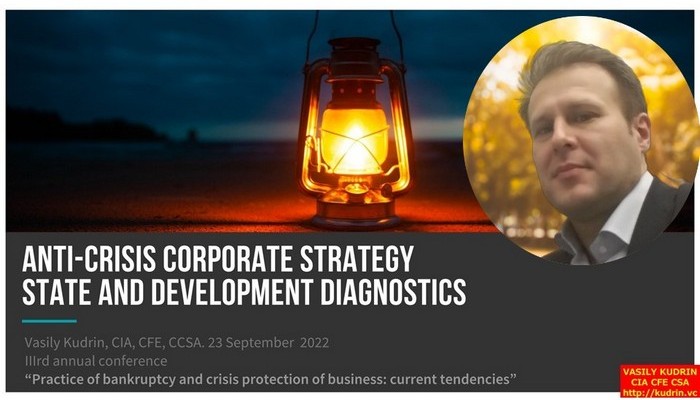
Vasily Kudrin, Partner, Head of advisory (risk management, control, corporate governance) at HLB Vneshaudit, made a presentation on counter-crisis business attitude and transformation on a prestigious professional conference devoted to anti-crisis protection of investment and business.
Presentation (ENG | RUS)
Coherent exposition of the presentation
1. Introduction, professional background. Vasily Kudrin introduces himself as a risk management specialist with experience dating back to the early 2000s. He explains that risk managers help companies, especially during a developing crisis, find strategies to counter threats and navigate complex situations.
2. Counter-crisis strategies. The role of risk management includes searching for various strategies, including radical ones. This may involve not only saving the business but also managing an orderly exit, bankruptcy, or relocating operations to other jurisdictions.
3. Practical experience, collaboration with lawyers. Despite the seemingly academic nature of the topic, the speaker has extensive practical experience, including in international asset recovery and forensic projects. He emphasizes that the greatest success is achieved through close collaboration between lawyers and forensic experts.
4. Importance of pre-litigation (forensic) investigation. Key results are often achieved at the pre-litigation investigation stage, when experts help locate hidden assets. Lawyers, in turn, need to understand a company’s internal processes during a crisis.
5. Understanding crisis processes within a company. Vasily Kudrin stresses that during a crisis, company processes typically follow predictable patterns. It is crucial for lawyers and experts to know which departments generate the information needed for risk management and how they do it.
6. Information accessibility. Early-career professionals often don’t know where to look for information; however, a significant portion (up to 90%) can be obtained from open sources on the internet.
7. Standard anti-Crisis mechanisms. The first reaction to a crisis is often to activate ready-made but rarely used business continuity plans. Another common tool is strategic sessions for top management.
8. Measures for a “smoldering” crisis. In a prolonged crisis, more effective measures are periodic crisis diagnostics and business transformation projects, up to and including complete restructuring or wind-down.
9. Goals and essence of strategic sessions. A strategic session is a structured discussion among top managers to visualize the situation, exchange views, and mobilize efforts. Its key task is to discuss specific risks—that is, events that could worsen the situation.
10. Sharing experience and finding solutions. These sessions facilitate a productive exchange of information on how competitors and partners are acting. This allows for sketching out effective action plans and finding new insights for navigating the crisis.
11. From seeing opportunities to realism. In current conditions, it is increasingly difficult to speak of opportunities presented by a crisis. More pragmatic topics are coming to the fore: bankruptcy, transformation, and business exit.
12. Strategic session methodology. The speaker presents his model of a strategic session (“the sphere”), which includes a set of topics for discussion (government, economy, society, etc.). For each topic, the moderator asks specific questions about risks and countermeasures.
13. Risk matrix and response measures. Risks are assessed by likelihood and impact, forming a matrix. Depending on a risk’s position in the matrix, one of four groups of measures is chosen: acceptance, transfer (e.g., outsourcing), increased control, or avoidance (exiting the business).
14. Framework of risk management in a company. Vasily Kudrin talks on risk management that is integrated systematically within a company’s strategy and management procedures. Risks – strategic, operational, financial, compliance – are derived from strategy, and control is implemented across several “lines of defense”—from operational units to internal audit.
15. Enterprise’s departments as sources of information. Specialized departments (internal control, compliance, audit) are where much useful information for bankruptcy or asset recovery procedures can be found, although conflicts of interest may also be discovered there.
16. Applying risk management for company protection. During a crisis, the focus shifts to a process approach: process objectives change to asset preservation, a rapid express assessment of the most significant risks is conducted, and primary attention is paid to financial risks (liquidity, reporting).
17. Value of risk indicators. Vasily Kudrin explains that risk indicators are events that do not themselves impede goals but signal potential future problems. During a crisis, their correct selection is critically important for forming an anti-crisis plan.
18. Recommendations for anti-crisis protection. The main principles are speed and flexibility in developing plans, aligning them with existing risk management practices, and actively using risk indicators to search for signals about the company’s condition.
19. Professional deformation and seeking new paths. Vasily Kudrin says that during a crisis, risk managers may experience heightened professional deformation, leading them to see everything in a negative light. However, it is important to seek opportunities for development, for example, in new technological fields.
20. Conclusion. The light in dark times. Despite the difficulties, one must be able to see the good and turn to innovation. The speaker gives a personal example of a successful transition into the field of digital assets, where his knowledge found new application, and urges looking at technological advancements.
 A.Life